History Major (BA, BS)
As a history major, you explore the intricacies of the past to better understand the present. You collaborate with faculty known for their extensive work in specialty areas covering medieval history, Latin American history, Native American history, Tudor and Stuart England, and Asian American history. You also have the flexibility to choose courses that match your interests and professional aspirations.
The skills you build—critical thinking, clear writing, public speaking, and problem solving—will be useful no matter what career path you follow.
Career Paths
Opportunities with a History Degree
The broad training you receive as a history major opens up numerous career options. Our history graduates are working in business, education, law, libraries, museums, and other diverse fields. You can find our graduates working for:
- Boeing
- George H.W. Bush Presidential Library & Museum
- Illinois Student Assistance Commission
- Milwaukee Film Festival
- Monsanto
- New York Legal Aid
- Peace Corps
- Teach for America
- Wells Fargo
- Truman Library Institute
Graduate School
Our Bachelor’s degree in history provides excellent preparation for graduate studies. Our graduates have a successful record of gaining access to a variety of graduate and professional programs:
- St. Andrew’s University
- St. Louis University Law School
- Texas A&M University
- University College London
- University of Illinois
- University of Kentucky
- University of Texas – Austin
- Drake University Law School
Featured Courses
Explore world history from the beginning of human existence and the emergence and development of societies in major areas of the world: West, South, and East Asia; North and Sub-Saharan Africa; the northern Mediterranean; Europe, and North and South America.
With a focus on American history from the initial period of European settlement in North America through the Civil War, you learn how historical interpretation is shaped by theory, scientific method, moral, and political choices.
Investigate the themes and problems in Western historiography from antiquity to the present and become familiar with the scholars, texts, and debates in the field as well as the impact of theory on the representation of the past.
Combine and build on the knowledge and research skills you have acquired to create an original research project.

Student Opportunities

Internships
As a history major, you become confident applying your skills through internship experiences. Popular internship destinations for history students include the Judicial Archives Project, Harry S. Truman Presidential Museum and Library, National WWI Museum, and Missouri History Museum.

History Fellowships
The Historic Deerfield Summer Fellowship Program is one of the summer fellowship opportunities for history students at Truman.

Research and Student Projects
An engaged and dynamic learning community, the supportive faculty members in the History Department encourage you to explore topics that fit your interests and goals.

Senior Seminar Projects
This capstone experience provides an opportunity for you to take the insights you gained from your previous courses and apply those insights to the production of a polished and sophisticated independent research project.

Student Organizations
Qualified students are invited to join Phi Alpha Theta, a history honors fraternity. The Historical Society mixes the present and past with service events and celebrations of national and international history.

Study Abroad
Join history faculty members on study abroad trips to China or Cuba, or pursue one of the 500 programs offered through Truman's Center for International Study.
News
March 25, 2024
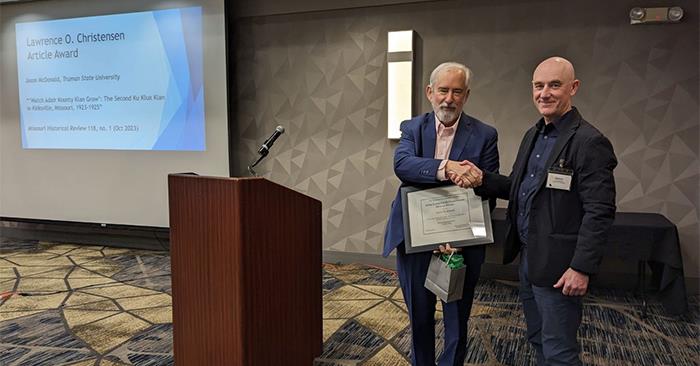
Jason McDonald, assistant professor of history, won the Lawrence O. Christensen Award for his article “‘Watch Adair County Klan Grow’: The Second Ku Klux Klan in Kirksville, Missouri, 1923-25,” which was published in the Missouri Historical Review in October 2023. The Christensen prize is awarded to the best article on a Missouri history topic published […]
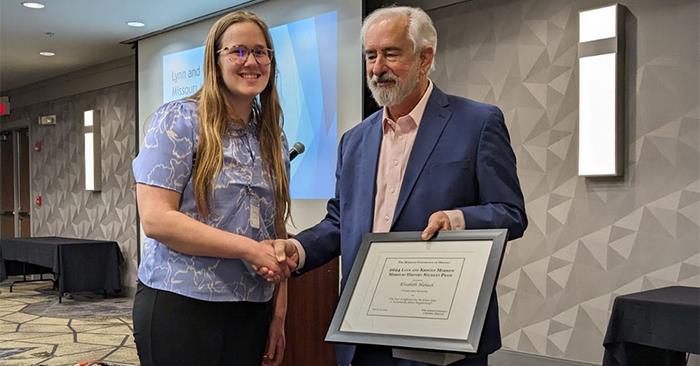 Students present and one wins a prize
March 25, 2024
History major Elizabeth Nahach won the annual Lynn and Kristen Morrow Prize for best student paper at the recent Missouri Conference on History held in Columbia on 15 March 2024. Besides Nahach History majors Nathan Dowell, Véla Lightle, Logan Kammerer and history/anthropology major, Micaela Reiss, also represented Truman at the conference. The five students by […]